Scheduling Guides
How to Prepare a Substitute Paraprofessional Schedule
By Para Schedule4 min read
A substitute paraprofessional schedule should answer four questions quickly: Where do I go? When should I be there? What is my assigned role? Who should I ask for help?
The person covering the day may be unfamiliar with your classroom, building, or usual routine. A clear schedule gives them a practical starting point and makes it easier for the lead teacher to explain what matters.
Start with the normal routine, then review what is different on the date being covered.
Start with the actual day
A weekly schedule is a useful foundation, but check the day’s assignments before handing it to someone else.
Look for assemblies, room changes, special activities, revised arrival or dismissal arrangements, and other exceptions. Include the date prominently so an older printout is easy to recognize.
If a change applies only to that day, keep it separate from the recurring weekly routine. That helps prevent a temporary arrangement from becoming next week’s accidental default.
Include six practical details
For each scheduled block, include:
- Start and end time: Show when the responsibility begins and finishes.
- Location: Use a room number or recognizable place.
- Assigned duty: Describe the adult’s role in plain language.
- Lead contact: Identify the teacher or staff role directing the activity.
- Transition: Allow for moving between locations when needed.
- Handoff: Explain where to report or whom to check with when the block ends.
Replace vague entries such as “help out” with a specific responsibility agreed with the supervising teacher.
The schedule should make the assignment understandable without becoming a page of dense instructions.
Example: a morning schedule
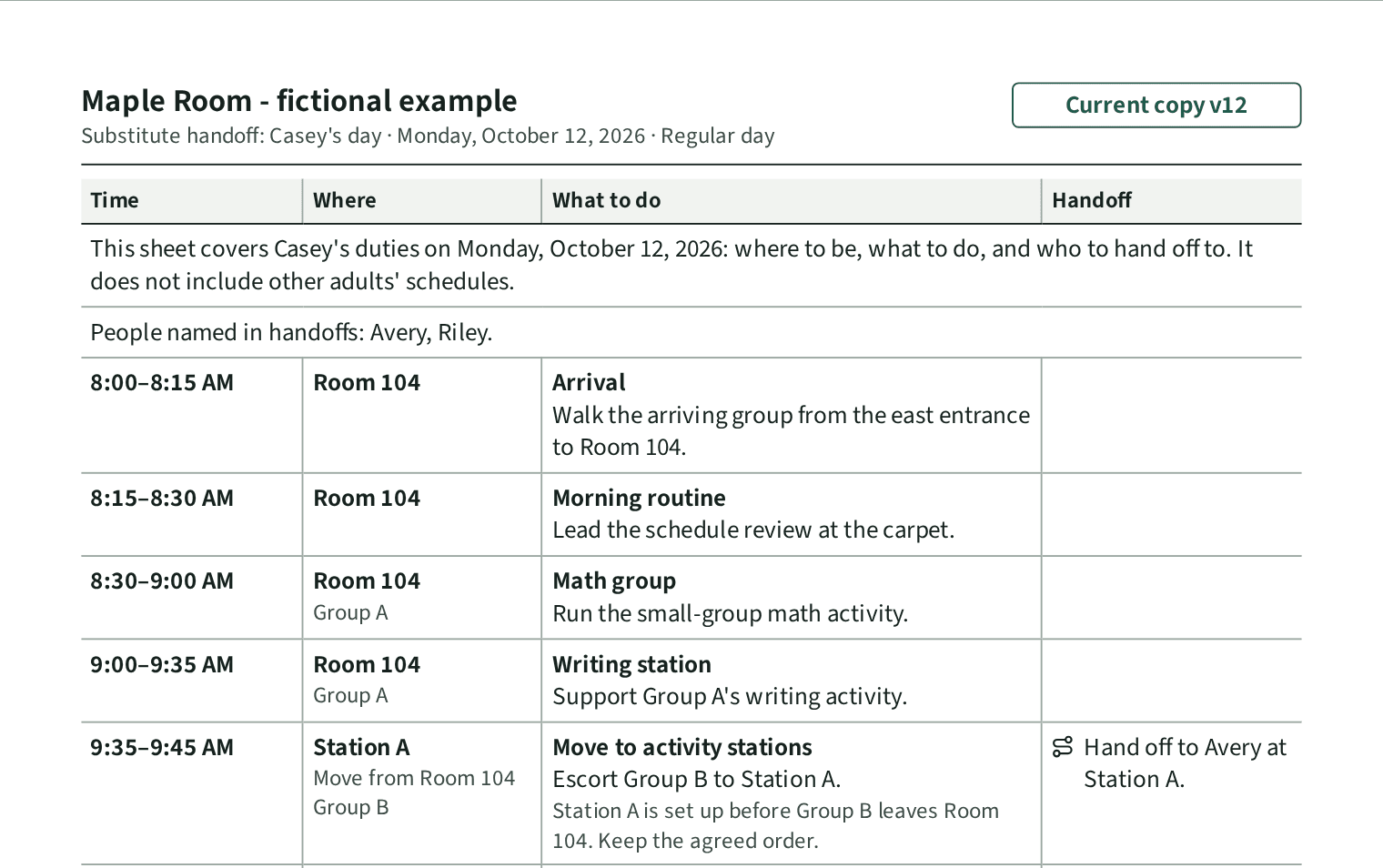
The following is a fictional example of part of a school day. Adjust assignments, breaks, and coverage to your school’s approved arrangements.
| Time | Location | Assigned duty | Handoff or contact |
|---|---|---|---|
| 8:00–8:15 | Room 104 | Check in and review the day’s assignments | Lead teacher |
| 8:15–9:00 | Room 104 | Support the classroom activity as directed | Classroom teacher |
| 9:00–9:05 | Hallway to Room 106 | Move to the next assignment | Report to Room 106 |
| 9:05–9:45 | Room 106 | Assist with the assigned small-group activity | Classroom teacher |
| 9:45–10:00 | Staff area | Scheduled break after confirming coverage | Check with lead teacher before leaving |
The useful detail is the combination of time, place, duty, and contact. Someone unfamiliar with the routine can see both the current assignment and what comes next.
Add a brief handoff note
Put essential orientation information near the schedule:
- Where to report at the beginning of the day.
- Who can clarify or change assignments.
- Where to find necessary classroom materials.
- How to get help through the school’s approved process.
- Where to check in before leaving.
Keep student-specific records and sensitive instructions in the school’s approved systems and handoff process. A general adult-duty schedule should stay focused on staff responsibilities.
Do not assume the substitute can take on every duty of the absent employee. Confirm assignments and any required preparation with the appropriate school staff.
Check coverage before distributing the schedule
Review overlapping assignments, transitions, and breaks with the person responsible for staffing.
If someone appears in two rooms at the same time, resolve the conflict before printing. If a handoff depends on another adult arriving, make that responsibility clear.
A schedule records the plan. The responsible teacher or administrator still needs to confirm that the plan works.
Make the printed copy easy to use
Use readable type, clear time ranges, and consistent room names. Avoid relying on color alone to distinguish duties.
Place the date and an “updated at” note near the top. Give the substitute a clear way to confirm whether the printed copy is still current.
If your team uses both full-page and pocket copies, check that they reflect the same assignments. When the plan changes, replace outdated copies or clearly communicate the revision.
A final handoff checklist
Before the day begins, confirm:
- The correct date is shown.
- Temporary changes have been included.
- Each block identifies a location and duty.
- Breaks, transitions, and coverage have been reviewed.
- The substitute knows the lead contact.
- Everyone is using the current version.
Preparing the schedule in Para Schedule
Para Schedule is built around adult-duty schedules for paraprofessionals. A recurring weekly routine, date-specific changes, and printable views can help you prepare a clear version for the day being covered.
The schedule supports the handoff; the lead teacher’s briefing supplies the context.
Start with an existing schedule or template, review the date you need, and prepare a current copy using Para Schedule.